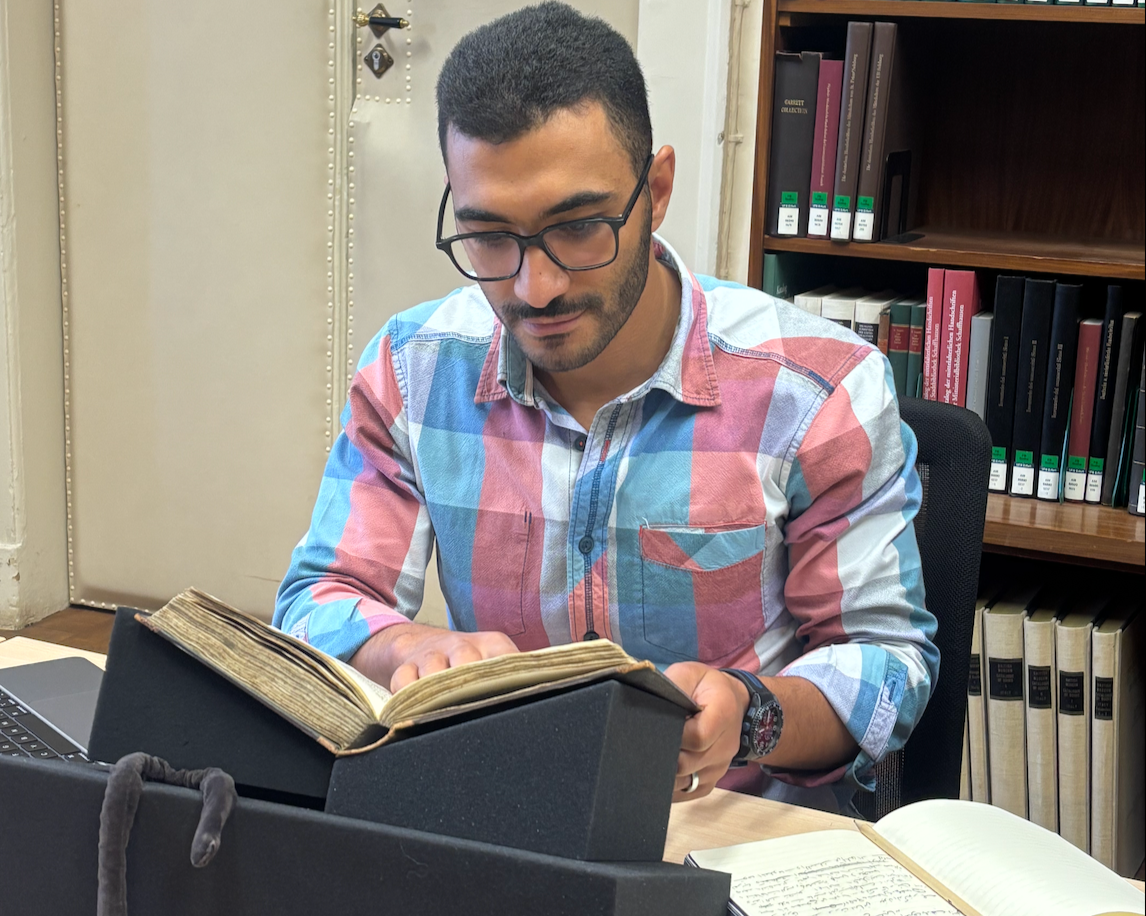
Ragab Kamal in Gotha
Egyptian Material Heritage in German Collections: Manuscripts of Hajj and the Hijaz as Case Studies
Within the framework of the Ta’ziz Science Cooperation Project (2023–2025), I, Ragab Kamal Abouhalima, PhD student at Philipps-University Marburg, participated in a scholarly visit to the Research Library in Gotha, focusing on Islamic manuscripts of Egyptian origin that were transferred to Germany, particularly during the eighteenth century. This visit formed part of the Gotha Workshop on Islamic Manuscripts, one of the core components of the Ta’ziz project, and represents an essential step in the development of my doctoral research on Egyptian material heritage in Germany.
The workshop provided hands-on access to the Islamic manuscript collection of the Gotha Library and enabled research approaches that combine textual analysis, material studies, and perspectives from digitization and digital humanities. Of particular relevance to my doctoral project were manuscripts related to the Hajj and the Hijaz, which serve as key case studies for tracing the routes through which Egyptian texts, knowledge, and material culture traveled to Europe, as well as for examining the cultural and intellectual impacts of these movements.
The visit took place in close connection with academic activities at Philipps-University Marburg, held shortly before the Ta’ziz Final Conference entitled “Dealing with Material Culture in the Eastern Mediterranean: Between Excavation and Digitization” (17–20 December 2025). Contributions by scholars from Ayn Shams University highlighted the depth of Egyptian–German research collaboration, addressing topics such as late Mamluk manuscript production, furūsīya literature, and military and chivalric culture, all of which underscored the close relationship between manuscript texts and material practices.
Overall, the Gotha visit reinforced the importance of balanced and sustainable academic partnerships and offered valuable perspectives for my doctoral research on the presence, circulation, and reinterpretation of Egyptian material and textual heritage in German collections, situated at the intersection of historical scholarship and digital methodologies.